The Geometry of the Soul: From Ancient Mandalas to Modern Fractals
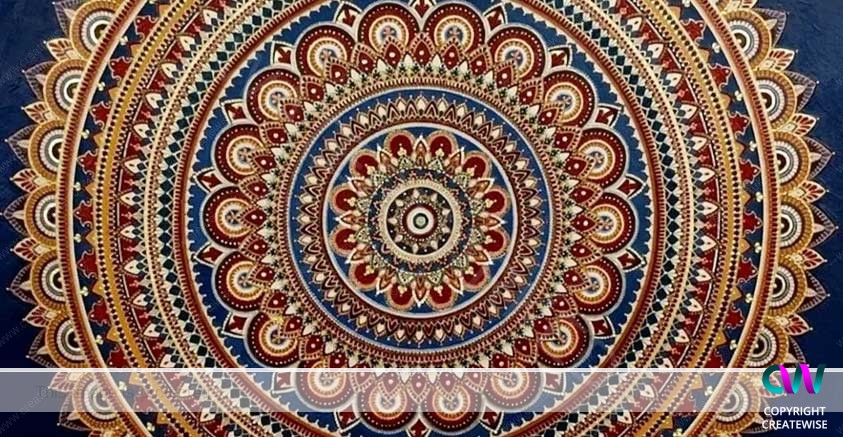
For thousands of years, the mandala—a Sanskrit word meaning “circle”—has served as a map for the inner journey. Whether sand-painted by Tibetan monks or etched into the stone of Gothic cathedrals, these intricate, symmetrical designs are more than just art; they are sophisticated tools for meditation and psychological integration.
Mandalas as a Meditative Anchor
In meditation, the primary challenge is often the “monkey mind”—the tendency for thoughts to leap restlessly from one distraction to another. A mandala acts as a visual anchor. By focusing on the center (the bindu) and moving outward through layers of geometric patterns, a practitioner can:
-
Induce a Trance State: The repetitive patterns help quiet the analytical left brain, allowing the intuitive right brain to take over.
-
Symbolize Wholeness: The circular boundary represents the universe and the self, helping the meditator feel a sense of “centeredness” amidst the chaos of life.
-
Externalize the Internal: Jungian psychology suggests that creating or meditating on mandalas helps individuals organize their internal clutter into a harmonious structure.
The Modern Mirror: Fractals and Mathematics
While mandalas are ancient, modern science has discovered a similar language in fractals. A fractal is a mathematical set that exhibits a repeating pattern at every scale—no matter how much you zoom in, the complexity remains the same.
The link between the two is profound:
-
Self-Similarity: Just as a mandala repeats shapes to create a larger whole, fractals (like the Mandelbrot set) show that the “part” contains the “whole.” This mirrors the spiritual concept of the microcosm reflecting the macrocosm.
-
Visual Complexity: Modern digital fractals are often used in contemporary meditation. Their infinite depth can lead to a “flow state,” where the viewer loses their sense of time and ego, much like a traditional monk focused on a silk thangka.
-
The Geometry of Nature: We now know that the universe is “fractal”—from the branching of veins in a leaf to the spiral of galaxies. By meditating on these shapes, we are essentially meditating on the blueprint of reality itself.
Conclusion
Whether it is a hand-drawn circle or a computer-generated fractal, these geometric structures resonate with the human psyche. They remind us that beneath the apparent randomness of life, there is an underlying order and beauty. By gazing into these patterns, we aren’t just looking at a design; we are looking into a mirror of the infinite.