
Fractals represent a bridge between mathematics, nature, and the human spirit.
They are complex patterns that look similar regardless of how much you zoom in or out—a property known as self-similarity.2 From the jagged edges of a coastline to the inner peace found in a mandala, fractals reveal a hidden order in what often looks like chaos.
The Origins and Discovery of Fractals
While humans have observed fractal patterns for millennia, the formal mathematical definition arrived relatively recently.
- Benoit Mandelbrot (1975):4 A Polish-born mathematician, Mandelbrot is the "father of fractal geometry."5 He coined the term "fractal" from the Latin fractus, meaning broken or fractured.
- The Mandelbrot Set:
Perhaps the most famous visual in mathematics, this set is defined by the simple iterative equation:7$$z_ = z_n^2 + c - Breaking Euclidean Norms:
Before Mandelbrot, geometry was mostly about smooth shapes (circles, triangles, cubes). Fractal geometry allowed scientists to describe the "roughness" of the real world. - Fractals in the Natural World
Nature rarely moves in straight lines. Instead, it uses fractal branching to maximize efficiency, such as surface area for nutrient absorption or gas exchange.
Natural Examples
Fern Leaves
Each leaflet is a miniature version of the entire frond.
River Networks
Small streams feed into larger rivers in a repetitive branching pattern.
The Human Lung
Bronchioles branch out to create a massive surface area for oxygen.
Romanesco Broccoli
A stunning example of a logarithmic spiral where each bud is a mini-cone. - The Sacred Connection: Mandalas and Fractals
Long before the math was formalized, spiritual traditions used fractal-like designs in Mandalas.
A mandala is a geometric configuration used in Hindu and Buddhist traditions to represent the cosmos or the "inner self."
Recursive Symmetry:
Many mandalas feature a central point with layers of repeating patterns radiating outward.11 This mirrors the fractal concept of the "part containing the whole."
Microcosm and Macrocosm:
The fractal nature of a mandala suggests that the individual (the micro) is a reflection of the universe (the macro). - Meditation, Mindfulness, and Contemplative Practices
Why do we find staring at a fractal—or a forest canopy—so soothing? Research suggests our brains are wired to process fractal patterns with ease, a phenomenon sometimes called fractal fluency.
1. Stress Reduction
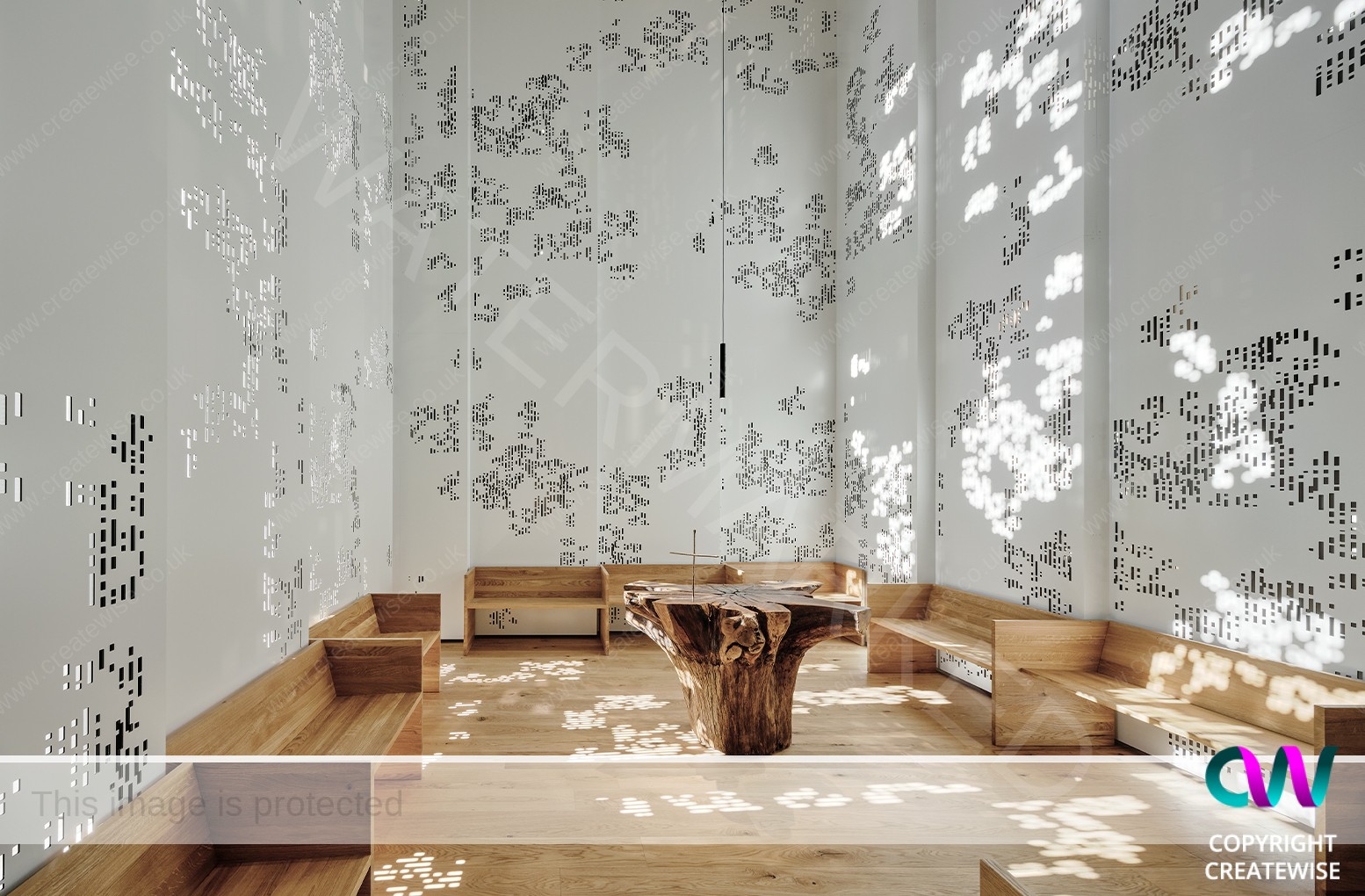
Looking at fractals can reduce physiological stress. Because our visual systems evolved in nature, we are "tuned" to fractal dimensions. Incorporating fractal imagery into meditation spaces can help induce a state of relaxation. - Mindfulness and Focus
In mindfulness, we often focus on the "here and now." Following the infinite complexity of a fractal helps anchor the mind. Just as a fractal never ends, the process of observing one keeps the practitioner present, preventing the mind from wandering into the past or future. - Contemplative Wonder
Fractals evoke a sense of awe. Contemplating the infinite—the idea that a finite space can contain an infinite boundary—shifts our perspective from our small daily worries to the vast, interconnected complexity of existence. - Summary:
The Infinite LoopFractals remind us that order exists within complexity. Whether you are looking through a microscope, a telescope, or inward during a meditation session, you are likely encountering the same fundamental patterns that govern our reality.